Many recognize Dr. Emily Thomas from her work with Dr. Jan Pol on “The Incredible Dr. Pol.” She bravely opened up about a particularly challenging and ultimately heartwarming journey involving her own Saint Bernard, a tale she shares below:
I never imagined myself owning a Saint Bernard. They simply weren’t on my radar, much like the idea of living in Michigan.

Then, one day, while working my first job in South Carolina, a local dairy farmer brought in a newborn puppy. She ran a dairy and had a small Saint Bernard breeding operation on the side. Her female dog had just given birth, but had tragically end3d all but two of the puppies, and one of the survivors had a severely injured back leg. Initially, it looked like a simple puncture wound on the outside of the hind leg. We cleaned it and sent the puppy home with antibiotics.

The next day, the farmer returned with the puppy. The leg wound had worsened, was draining pus, and the foot was cold and stiff. We gave the puppy a grim prognosis; infection had set in, and a newborn, fragile baby with a dead leg was unlikely to survive. The farmer, with all her responsibilities managing a dairy, didn’t have the time to dedicate to such a sickly puppy. She decided that euthanasia would be the most humane option since he wasn’t improving.

Looking at this beautiful puppy, perfect in every way except for his mangled rear leg, I couldn’t bring myself to inject his tiny heart and then place him in the freezer where we stored deceased animals. At this point, I was just finishing my first trimester of my very first pregnancy (with India). We had only moved to this town five months prior, were renting, and already had two dogs, two cats, and two horses. It was absolutely not the right time to consider taking on another dog, especially one that would require five weeks of intensive care and eventually grow to over 100 pounds. I discussed it with my best friend and coworker, Kim, who encouraged me to take on this (currently) one-pound challenge.
I spoke to the farmer about surrendering him so we could attempt to amputate the leg and save him. She was in tears. She was a tough woman, running a dairy farm, but she had a truly wonderful heart. She was devastated at the thought of putting him to sleep, but grateful that we would at least give him a chance. I had him signed over and was now the owner of a very sick infant Saint Bernard. What had I gotten myself into? What would Tony say when I got home? I knew he would understand—he knows who he married—but he’d probably shake his head a bit.

The next day was scheduled for surgery. I had to meet my boss at a dairy first to continue learning how to efficiently palpate cattle for pregnancy. The upcoming surgery replayed in my mind. Finally, we finished with the cows, and I drove to the clinic to operate on this three-day-old puppy. We anesthetized him with just valium and then masked him with gas. Three of us gathered around this one-pound patient: Kim, our assistant; the other doctor at the clinic monitoring the anesthesia; and me, operating on what felt like a KFC chicken wing. I dissected down to the femur, at some point severing the femoral artery, which was so tiny it didn’t bleed. I used heavy Mayo scissors to score a shallow cut around the bone, like a glass cutter, and the bone easily broke in half.

I then filed the end of the bone to ensure it wouldn’t be rough on the muscles, closed the muscles around the bone tip, and finally, stitched the skin over the muscle. Whew! We were done! We took him off gas, put him on oxygen only, and waited for him to wake up. And we waited. And waited. He wasn’t waking up. That’s it, I thought, I knew this was stupid, but at least we tried, right? Then, the assisting doctor got some injectable dextrose and put just a couple of drops in his mouth. He woke up! Thankfully, she remained calm and remembered that neonatal patients can become hypoglycemic under anesthesia.
We took the puppy home, now named “Doomed puppy” due to my blend of pessimism and superstition. We had to bottle-feed him. The tiny nipple that came with the formula bottle was far too small for his mouth. We ended up having to use a soda bottle with the smallest goat nipple we could find. We also had to stimulate him to pee and poop until he reached a certain age. For the first few days of his life, he slept in a cardboard box on a heating pad in our bathroom and came to work with me every day. We had to set alarms to wake up every few hours to feed him.
One weekend, we traveled back to Georgia to announce my pregnancy to our families. We always took our dogs with us when we traveled, and the two large dogs were in the backseat along with the box containing the puppy. He was about two pounds at this point. Along the way, we stopped at Subway for dinner but didn’t want to leave the puppy alone in the car with the two dog-aggressive dogs. So, I picked him up, placed him in an inside pocket of my coat, and carried him inside. The workers there never realized I had a Saint Bernard in my coat pocket.

After that, I smoothed the end of the bone so it wouldn’t irritate the muscles, then wrapped the muscles around the bone tip, and finally, stitched the skin closed over the muscle. Done! We took him off the gas, put him on oxygen, and waited for him to wake up. We waited and waited. He wasn’t stirring. I thought, “This was a mistake, but at least we tried, right?” Then, the assisting doctor grabbed some injectable dextrose and put a couple of drops in his mouth. He woke up! Thankfully, she stayed calm and remembered that newborns can become hypoglycemic under anesthesia.
We took the puppy home, now dubbed “Doomed puppy” due to my blend of pessimism and superstition. We had to bottle-feed him. The small nipple that came with the formula bottle was too tiny for his mouth, so we ended up using a soda bottle with the smallest goat nipple we could find. We also had to stimulate him to pee and poop until he reached a certain age. For his first few days, he slept in a cardboard box on a heating pad in our bathroom and came to work with me every day. We had to set alarms to feed him every few hours.
One weekend, we drove to Georgia to announce my pregnancy to our families. We always brought our dogs when we traveled, so the two larger dogs were in the backseat along with the puppy’s box. He was about two pounds at this point. On the way, we stopped at Subway for dinner, but I didn’t want to leave the puppy alone in the car with the two dog-aggressive dogs. So, I picked him up, tucked him into an inside pocket of my coat, and carried him inside. The Subway workers never realized I had a Saint Bernard in my coat pocket.
Eventually, we settled on the name “Merlin.” He continued to live in our bathroom, and he particularly loved the bathtub. Every night at bedtime, he would just shuffle into the bathroom and flop himself into the bathtub to sleep. Having only had three legs his whole life, we assumed he would have no trouble learning to walk with three legs. Just like four-legged dogs who undergo amputation later in life seem to manage fine and “don’t miss a step,” we thought he’d have even less difficulty adapting. We were wrong.

Having basically been born with just the three legs and having never learned to walk properly, he would just scramble. He would pull his body along with his front legs and kind of paddle with his one hind leg. Thanks to the advice from my friend, Kim, we sought a Veterinary specialist in rehabilitation in Columbia, SC. She was able to make some chiropractic adjustments, and fit him for a cart for us to borrow. He hated that cart. We would harness him up and he would freak out and run around the room, getting caught on furniture and knocking over everything. We were finally able to harness him up and take him on walks in the neighborhood. It took a lot of practice, and he grew quickly and eventually had to return the cart, but by then, he had learned better how to get up on that back leg.

He eventually got along on that back leg like it was nothing. We couldn’t take him on long hikes and I could only take him on a 1 mile “warm up walk” before my run so that he got to feel like he was part of the pack too, but he also loved to play tug-of-war – which is typically not recommended for pets because it can make them think everything is a game when you’re trying to take things from them – but this was his main method of exercising, and I could just tell him to drop it and it was over.
He loved vegetables, fruit, tissues, and baby socks. He would wait in the kitchen while I cooked, waiting eagerly for kale stems, carrot ends, strawberry leaves; would follow the kids around or sit next to me while strings of drool hung at his lips if we dared to eat an apple around him. He EXPECTED the core. He would run outside and help the horses eat watermelon rinds or try to find the scattered sweet potato skins I had just thrown out for the deer. If you left a paper towel or tissue within reach, he would stalk it because he knew he would get into trouble for eating it and the moment we weren’t paying attention, he would suck that thing down like it was a piece of cotton candy. Even when the kids were babies and we were in a complete state of chaos, if we forgot to close the baby wipes when we were done, you would catch him sucking each one down as it pulled up the next – like his own tissue Pez dispenser. His love of baby/kids socks got him in trouble too. We would constantly have to go out and buy more to make up for his dietary needs. Our kids were so trained not to leave their socks on the floor downstairs that if we went and visited another person’s house, our kids would come up to us and ask us where they could safely put their socks. Between the tissue diet and socks he consumed, once spring rolled around and we mowed the lawn for the first time the mower would spray our yard with confetti of tissue pieces and colorful sock remnants.

As Merlin got older, he would go through phases where he couldn’t walk as well anymore. Most of the time, he responded to pain medication, time, or a chiropractor adjustment. I took an x-ray of his hips to see the horror that I was afraid of. His only hind leg he had was suffering from horrible hip dysplasia. I knew, even though we were very diligent about keeping his weight down, at 120lb, it was still only a matter of time before he completely tore his cruciate ligaments in his only knee and then it would be done.

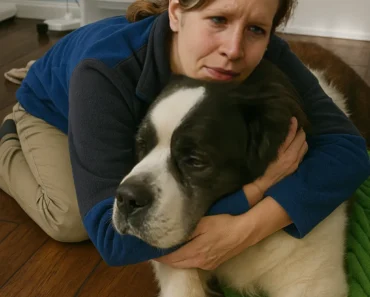
He was definitely MY dog. Tony would tell me that if I wasn’t home, Merlin would just lay in the corner of the dining room all day, not moving even to go outside. He did NOT appreciate the kids and as he got older, he only became more cranky with them, especially when they got crazy silly.
This past fall, he started having trouble walking again. We knew, at almost 9 years old, anytime could be his last. He was no longer getting up on his back leg anymore and would just scramble along the wooden floors. We would assist him outside and, at first, he would get up on the leg to go to the bathroom. We had him on three different pain medications, joint supplements he had been on his whole life plus a few more, got him some fancy Dr. Buzby’s toe grips, a Help ’em up harness, but still he dragged that stump around. Eventually, he stopped eating as much and the stump became raw and bloody. We had smears of bloody trails across our floors where he had needed to be with me. I altered his harness to pad the stump, but it wouldn’t stay where it needed to. I brought home an “After surgery wear” from work and altered that to pad his stump. That seemed to work better.
I had been avoiding it. I was in denial. When he would use every last bit of energy in his painful body to get to where ever I was in the house, I just knew he depended on me, how could I let him down? But finally, I stayed outside to watch him go to the bathroom, because now he was soaking his after-surgery wear every time he peed.

To my horror, and with tears running down my face, I saw him drag himself to a spot and just sit and pee all over himself. Then, he dragged himself to another spot and pooped while sitting, only swinging his rear away to keep the poop from sticking to him. I knew it was time.

The final day, he was so excited to get to go in the car with us, as that was a rare occurrence for him. We were feeding him Milkbones like he was starving and he just thought that was the best. My mother even met us at the clinic and brought him a porkchop wrapped in a paper towel. He chomped that down too, paper towel and all. He was just having the best day! Of course, it took me and Tony to get him out of the car and into the clinic to our euthanasia room. He required a sling to hold his hind end up. But he just dragged us in, found the few people working after-hours, his tail just flagging like the happiest pup.

We finally got him to the euth room and he stumbled and collapsed on the floor. Tired, from all his happiness. I gave him the sedation, then cuddled his giant bear head in my lap as the final injection was given. He was only 3 days old when I decided it wasn’t his time to go to the freezer and even though I had given him 3,200 more days of pure love, it still felt like I had abandoned him as we gently lowered his body, finally, into the freezer.
BYE BUDDY.
I don’t know what I would have done without him, and the house feels so empty now. Even though he’s no longer by my side, every memory of his clumsy, loving presence is etched into my heart. Goodbye, my sweet boy. You will always be in my heart.