Is Dr. Jeff Baier still with Dr. Jeff? Wife, Wikipedia bio.

Dr, Jeff Baier is a veterinarian turned reality tv star who you’ll see on Rocky Mountain Vet. Jeff’s passion and love for animals is not only genuine, but also stems from an adventurous childhood. As a kid from Nebraska, he was fortunate enough to interact with a wide range of animals, which enabled him to develop an appreciation for them.

Being in close proximity to a farm meant that he learned a great deal about animals. Let’s look at several interesting facts about Dr. Jeff Baier’s wife and biography.

Is Dr. Jeff Baier Still on Dr. Jeff Rocky Mountain Vet?

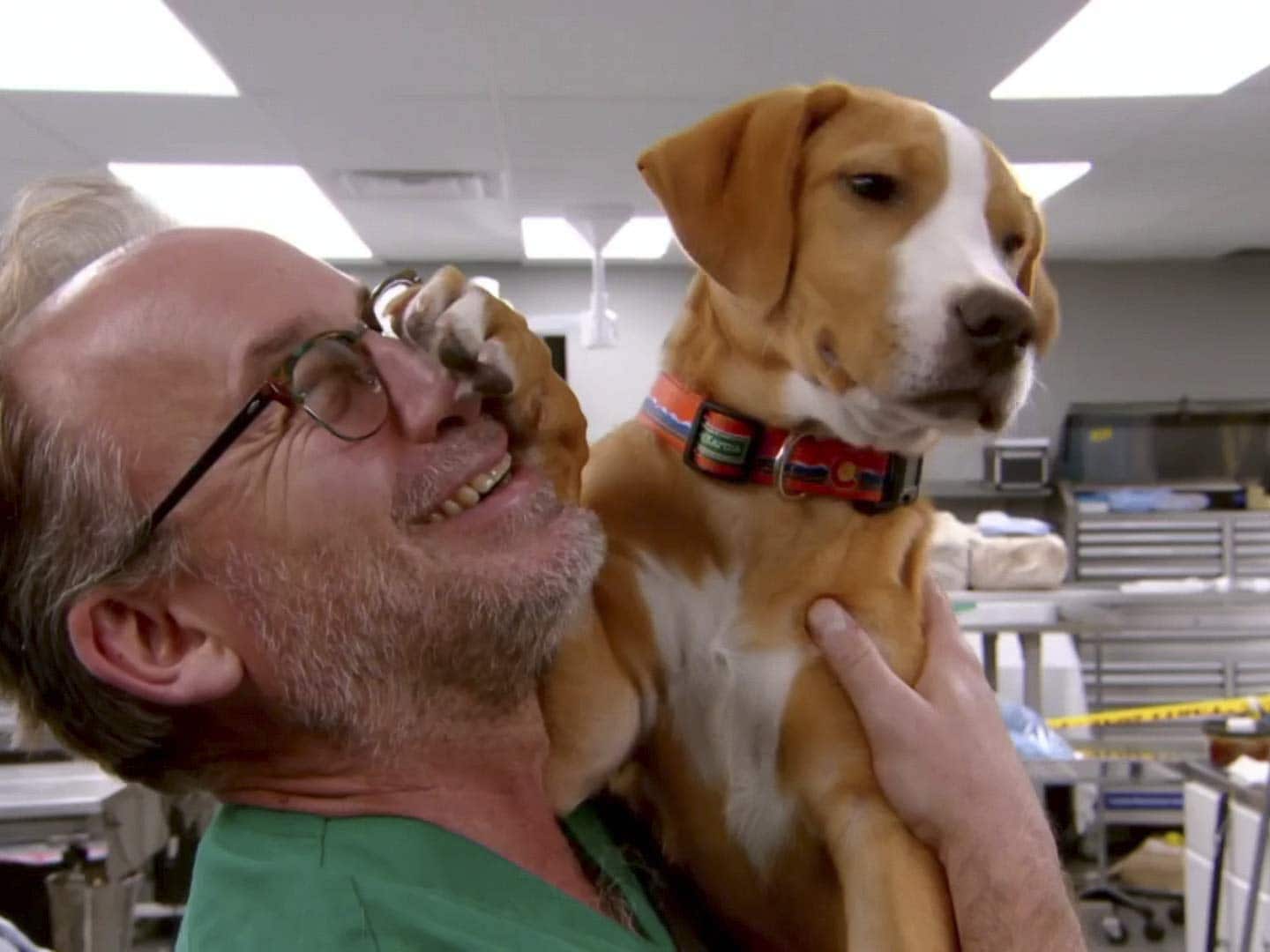
Image of Dr. Jeff Baier when he returned to the vet care clinic
Dr. Jeff Baier when he returned to the vet care clinic

Dr. Jeff Baier was first introduced to the Rocky Mountain Vet audience as the clinic’s exotic animal specialist. This means that it was his job to cater to animals like rhinos, wolverines, and other animals the clinic are ill equipped to deal with.

Initially, his appearances on the show were few and far between, though this did not stop him from being a fan favourite. As the years progressed, however, he became a mainstay on the series, appearing in even more episodes.

One of Dr. Baier’s crowning moments on the series came when he spayed a set of exotic rats. Recently, there have been reports that claim that Dr. Jeff Baier left the cast of Rocky Mountain Vet. Most of these reports stem from the fact that Baier runs his own veterinary clinic. As such, his schedule is already packed as it is.

So is Dr. Baier still on the show? Most fans will be pleased to know that Baier is still a part of Dr. Jeff Rocky Mountain Vet. When the eighth season of the show aired back in March 2022, fans watched as Dr. Baier treated a parrot who couldn’t stop sneezing. Throughout the next few weeks, he’d feature on eight episodes in total. At one point, Jeff Baier was even on hand to perform the very first goose operation at the clinic. This will only solidify his position on the show.

 Is Dr. Jeff Baier married to a wife?

Dr. Jeff is the husband of a woman named Angela Baier. Incredibly, Baier and his partner live in a zoo/animal shelter which they constructed on their own. The animals they have at home include a turtle, 3 cats, 4 tortoises, a harmit crab, and 4 dogs.

Jeff and Angela’s home is essentially a sanctuary for all manner of creatures. At one point, the two even had a bearded lizard and an eagle to look after. Before their 25th wedding anniversary, the couple faced a real health scare. Jeff and Angela were set

to embark on a trip to Africa to mark the special milestone they were about to cross.

Before they could travel, they needed malaria vaccine shots to prevent them from getting tropical diseases. Unfortunately, Dr. Baier was also suffering from a cold at the time.

Despite this, he had his shot anywhere, and his condition worsened. It got to a point where his temperature was too high. One weekend, his wife found him passed out and unresponsive on the floor. It was then that she decided that it was time to take her husband to the hospital.

Angela’s quick decision making saved her husband’s life, as the doctors discovered that his appendix had ruptured. Had they waited a few more hours, he would have surely died. While he was recovering, Jeff’s wife spent every waking moment next to him. This was a reflection of the kind of relationship that the two of them had.

Wikipedia (early life, education, career, social media activity)

Jeff Baier is a native of the great state of Nebraska. A brief look at his history reveals that he grew up in a farm, where he got the chance to interact with all the animals on deck. Additionally, he was also inspired by the reality show, Wild Kingdom, which, steered him towards the direction of veterinary medicine.

He committed to becoming a vet, consequently joining the University of Nebraska, where he studied Biology and Avian Nutrition. After this, Jeff enrolled at Kansas State University, officially pursuing a degree in vet medicine.

Upon graduating with honours, Jeff got the chance to work with exotic animals at the Denver zoo. This is a position he’d hold for about a decade before moving to his next place of employment.

Over the next few years, Jeff would become an instructor at NYSWRC, as well as the head of the Association of Reptilian and Amphibian Vets. In 2007, he officially set up Biaer Veterinary Services.

The centre not only caters to pets, but also works with wildlife rehab institutions. Jeff doesn’t have much in regards to a social media life, which isn’t surprising, considering his age and busy profession. In fact, all we could find was a profession LinkedIn profile, which provides a detailed account of his work experience.

Dr. Jeff Young Vet’s Biggest Controversies and Accusation

Dr. Jeff Young is an experienced veterinary officer, and the head of Planned Pethood Plus. This was a health centre he set up in Colorado to help animals all around.

Dr. Jeff and his team have helped hundreds of animals over the years, ranging from dogs, cats, to even farm animals. Gradually, Jeff and his team grew in popularity, leading to a stint on television.

Since it was first released in 2015, Dr. Jeff: Rocky Mountain Vet has aired a total of eight seasons. With fame, however, came its on fair share of controversies. These are what we will examine today.

He was accused of health violations

Back in 2017, a video of Dr. Young performing surgery on an animal sparked outrage amongst the veterinary community. In the video, Jeff was in the process of performing an invasive surgery on an animal.

However, he had not bothered to put on a mask, or any other protective gear. The other vets who were assisting him with the procedure had also not bothered to wear any protective gear as well.

Unsurprisingly, the video garnered negative publicity, prompting the American Veterinary Medical Association, an animal right’s organisation, to step in. The organisation’s president wrote a scathing letter to Animal Planet, the network that runs Dr. Jeff Young’s reality show.

He criticised the medical protocols that Dr. Jeff and his team had in place while they were conducting serious surgical procedures. The organisation went on to highlight the value maintaining proper sanitary conditions while performing surgeries.

Dr. Jeff Young Rocky Mountain Vet

This is because that an unsanitary operating station means that the animal in question is more prone to contracting infections post-surgery.

They argued that the cost of maintaining a sanitary workstation would not significantly altar the overall cost or time.

Aside from the AVMA, several fans also made their voices hard, criticising Dr. Young, and the producers of the show.

Sanitation is an issue at his animal shelter

Planned Pethood Plus is an organisation that helps thousands of animals every year. Unfortunately, this means that they handle large volumes of animals and pets at any given time. This means that they are typically squeezed into a tiny area.

What this means is that they are exposed to a variety of diseases that any of the animals housed there could contain. Moreover, an unsanitary living space will also lead to a higher risk of viruses and infections.

He is accused of frequently insulting other vets

Dr. Young is a vet with strong opinions, which, he doesn’t shy away from sharing. His centre, Planned Pethood Plus, was set up to cater for strays, and animals in general at an affordable rate. Every year, they set out to neuter/treat at least 3,000 animals.

Consequently, Dr. Young takes issue with other vets who charge exuberant rates for their services. Jeff has no problem referring to his colleagues as money hungry, which often causes friction with the medical community at large.

Dr. Jeff Young Vet kissing his wife Petra Young

This is because the money they charge for services mostly go into cutting edge medicine and technology. In general, these veterinarians are just trying to improve the overall quality of care, something they wouldn’t be able to do if they didn’t charge for their services.

He regular insults animal lovers

Fans of the show, and just animal lovers in general, are also not safe from Dr. Young’s ire. People tend to show affection for their pets in different ways. Some pet owners will buy their animal a wide range of toys, while others will put them in adorable clothes.

Jeff takes serious issue with the latter. In fact, he likes to ridicule people who dress their people in clothes, or adorable outfits. If that isn’t worrying enough, Dr. Young also has little respect for pet owners who treat their dogs/cats like members of the family. He believes in drawing a distinction between human beings and animals.

He is not a fan of breeders

Breeders take it upon themselves to genetically modify physical and mental traits they don’t like in animals. At times, they even go as far as to come up with entirely new breeds of animals. As such, their work is often questioned, and even criticized. Dr. Young’s criticisms, while valid, tends to be overshadowed by his over-the-top antics. He frequently insults breeders, which tends to dilute any valid point he may have.

Questionable programs on their network

Most people agree that Dr Jeff: Rock Mountain Vet is one paved with good intentions. Dr. Jeff and his team genuinely set out to help animals and improve their overall care and health. This is all showcased on the show, which, does its best to put the animals front and centre.

However, we can’t overlook the fact that the show was made by the same media company that created programs like Hippo Hunters.

Other than that, the same company also released controversial shows such as Fat Girls and Feeders. This is a controversial show that revolves around men who intentionally overfeed their partners so that they can grow larger, sometimes to the point where it comes a serious health risk.

All the good work Dr. Jeff and his team do is overshadowed by the controversies from the other shows from their parent company.

The equipment he uses at the clinic are dated

Most experts agree that Dr. Jeff Young and his team use outdated equipment and tools. This puts the animals they are trying to treat at risk.

Since they do not charge a lot for their services, Dr. Pol and his team do not have access to any of the state-of-the-art equipment you see at modern animal health centres.

Moreover, using archaic tools and methods will also reduce the likelihood of success. Some fans who watch the show agree that Planned Pethood Plus is not only clammy, and cluttered, but also dirty. As we mentioned before, they cater to hundreds of animals at a time.

Can Dogs Eat Scallops?

Scallops are a type of Shellfish that are highly sought after. They belong to the Pectinidae family, which encompasses other fish like oysters and clams. Though there are several types of Scallops, experts have found that the most common is the tiny bay scallops.

We also found that the term ‘Scallops’ is used about a plethora of marine bivalve mollusks. These Shellfish are present in all the oceans across the world.

Their popularity is huge due to their unique and delicate flavor. Moreover, the scallops’ texture is also quite popular. When prepared well, scallops tend to be delicious and tender, so much so that you don’t need to add anything other flavors. But can dogs eat scallops? Well, that’s what we are here to find out.

Are Scallops good for dogs?

Yes, in theory, dogs can eat Scallops, especially its foremost edible parts. We are of course, referring to the fish’s meaty abductor muscle. Generally, Scallops are classified as non-toxic, meaning that they will not have any adverse effects on your dog.

Some experts argue that their high protein and mineral content make them an excellent choice for your dog. However, like most foods, Scallops should also be consumed in moderation. Too many of them can cause your pet a few problems.

Additionally, Scallops should be prepared carefully before your dog can consume them. They need to be well-cooked, and you should avoid frying in general or the use of oils. Most dogs will be able to enjoy Scallops as a rare treat, or in some cases, as an ingredient in their dog biscuits.

Benefits of dogs eating Scallops.

To begin with, Scallops are usually considered to be an adequate source of protein. Having said that though, they shouldn’t serve as your dog’s primary source of protein.

At most, they should be an occasional treat, which, will give your dog the energy they need during playtime. Besides being a decent source of energy, the protein in the scallops will also give your pup stronger muscles, and better bone & body mass. If that’s not enough, a great quantity of protein will rapidly speed up healing in case of injury.

Image of Scallops
Scallops

Other than that, Scallops are also full of nutrients like phosphorus, which play a key role in the formation of teeth and bones. Additionally, these types of Shellfish contain magnesium and potassium. The former supports a healthy immune system while the latter plays a crucial role in the prevention of kidney stones.

Additional nutritional facts (100 grams of Scallops)

Protein

24 grams

Calories

137

Sugars

0 grams

Fat

1 gram

Carbs

6.3 grams

Fiber

0 grams

Sodium

660 mg

Health risks involved with dogs consuming Scallops

Though they are not considered dangerous for dogs to consume, scallops can have a few negative effects on your pet’s health. If your dog eats too many scallops, they are likely to suffer from digestive upsets. This is because their digestive systems aren’t built like ours.

The aforementioned ingredients are of-course fundamental when it comes to preparing Scallops. While we can easily handle butter, oils, seasoning, and salts, the same cannot be said for dogs. If your dog consumes fried scallops, then both of you are in for a rough night as it will work as a very strong laxative in this case.

They will experience several bouts of diarrhea, necessitating an immediate trip to the vet. In mild cases of stomach upsets, it will still be advisable to monitor them overnight while providing an adequate supply of water.

Another possible health risk is food poisoning. This is most common with scallops that swim around in polluted sections of the ocean. These fish will filter this dirty water, and in the process, pick up a variety of hazardous toxins that can lead to shellfish poisoning.

Moreover, scallops, if consumed raw, can also fill your pet with dangerous parasites and bacteria. The list of parasites is endless, ranging from salmonella, tape & roundworms, to listeria. Some common symptoms to watch out for when it comes to parasites include fevers, bloody mucus discharge, diarrhea, lethargy, and a diminished appetite.

How to prepare Scallops for your dog?

The first thing you need to remember is moderation. Dogs cannot consume an excessive number of scallops, as it will cause a lot of issues. It is best to reserve them as rare treats. So, how would you cook scallops for your dog?

Well, there are three things to consider. The first would be to avoid seasoning or the use of additional flavors completely. As we have already mentioned, dogs’ stomachs can’t handle the same things ours can, so avoid the use of salt, peppers, and other products. Secondly, you need to ensure that the scallops are completely cooked to kill bacteria and parasites.

Having said that, you shouldn’t overdo it, as too much heat will cause scallops to become too rubbery. These will cause digestive problems if not properly dealt with. Lastly, you should also choose the appropriate method of cooking.

Use a pan that you don’t normally use for your own food, as it may still have some oil residue. Other than that, you can also opt to steam or boil scallops while avoiding frying entirely.

Final Thoughts

To recap, dogs can consume scallops, but you must be careful when it comes to the quantity. Moderation is key, as it will be the difference between an upset stomach and a happy, healthy dog. These sShellfishhave been proven to be a good source of protein, while also containing some other vital nutrients.

You also must remember that raw or undercooked scallops can be dangerous, as they provide a platform for all parasites to thrive. One additionally thought we should add is that puppies should entirely avoid scallops. Their digestive systems are more sensitive than adult dogs. As such, don’t let younger dogs consume scallops.

Can Dogs Eat Couscous? Everything You Need to Know

Couscous is a North African delicacy that is made from small balls of semolina flour. Interestingly, most people often mistake it for cooked grain, though through no fault of their own as it has a similar constitution. Couscous is, in fact, a type of pasta.

In addition to its unique taste, it is also straightforward to prepare, with the added caveat that it can be served with various stews and sauces. Despite originating from Africa, it is a dish widely enjoyed across the globe.

Since most people love it so much, it is only natural for them to wonder if their dogs can eat couscous as well. Here’s what we know.

Is Couscous good for dogs?

YES, your dog can munch on couscous a few times a week. It is a whole grain that is derived from wheat, or barley, thus providing your dog with numerous nutrients and minerals.

Off the top of the list are selenium and fiber, the latter of which will improve your dog’s digestive tract. Like everything else, however, dogs should not consume too much couscous. Experts say that it does not provide them with all the nutrients they’ll need to thrive.

Most pet owners will opt for lean meat alongside couscous, as it will help balance out their dog’s diet. Some people will even throw in a bit of Greek yogurt along with the couscous to make it more appealing to their furry friends.

Image of Couscous
Couscous is good for dogs.

100 grams of Couscous contains:

Calories 112
Proteins 3.8 grams
Sodium 5 mg
Total Fat 0.2 grams
Sugar 0.1 grams
Potassium 58 mg
Total Carbs 23 grams
Iron 2%
Vitamin B6 5%
Magnesium 2%

How much Couscous Can your dog eat?

Most experts recommend starting off small, especially if your dog has never tried couscous before. The amount of couscous you let your dog eat will vary, depending on whether it’s just going to be an occasional treat or part of its regular diet.

On average, it’s advisable to offer a tablespoon of couscous for every 9 pounds of food you give your dog. Any more than this would be considered too much for them to handle.

Benefits of Couscous for your Dog.

As you can see from the detailed table above, Couscous contains a variety of minerals and vitamins. Selenium, which is one of the aforementioned minerals, plays a vital role in keeping your dog’s cells healthy and ensuring that they are fully functional. In addition to this, some studies even show that they can help prevent some forms of cancer.

Other than that, couscous is also a healthy treat for your dog. Because it is classified as wheat, it is additionally gluten-free. This means that it will not have any added ingredients that may prove toxic to pets. Moreover, it is a great source of plant-based protein, which will aid in your dog’s development.

A little bit of couscous will help keep your dog energized and active throughout the day. Lastly, because of all the vitamins prevalent in couscous, it often acts as an immune booster for your dog if given in moderation.

Risks related to feeding couscous to your dog

As with most meals, there are certain risks to navigate when offering couscous to your pet. To begin with, if consumed in large amounts, then your dog will get too much selenium into his system. Experts say this is a potential health hazard that will need to be addressed immediately. Another thing to be on the lookout for is allergies.

Some dogs are allergic to carbohydrates, especially ones with diabetes. If a diabetic dog gets his paws on some couscous, then they may experience symptoms like vomiting or even diarrhea.

Lastly, most people tend to prepare couscous with different spices and seasonings like salt, garlic, and onions. All three are considered hazardous to your dog’s health. They can not only cause serious stomach upsets, kidney problems, frequent urination, or even dehydration.

Image of prepared Couscous.
An unbalanced diet of Couscous can be dangerous for some dogs.

How to prepare couscous for your dog?

First off, you need to make sure that you use plain ingredients while avoiding spices in their entirety. Most people will opt to boil it for a couple of minutes before mixing it with either meat or vegetables.

Hope this article answers your curiosity about whether a dog can eat Couscous eat or not.

Can Dogs Have Teriyaki Chicken? Find Out

Teriyaki Sauce originates from Japan and is a loved recipe worldwide. People love this dish and often wonder if they can feed their dogs the same. So, is it okay for your paw friends to have Teriyaki Chicken? What about any other recipes, including the Teriyaki Sauce?

We have elaborated on the facts if dogs can have Teriyaki Chicken or not, so keep reading.

Can Dogs Have Teriyaki Chicken?

Let’s start with NO. Chicken is tasty and full of protein. They are also one of the dogs’ favorite foods. However, the compound becomes toxic and dangerous for dogs when Teriyaki is added. Let’s discuss why.

This dish has sodium in high amounts. It is not only unhealthy for dogs but is also toxic if taken in large quantities. The second ingredient in the Teriyaki Chicken is sugar. Problems like tooth decay, obesity, and diabetes can surface in your dogs if you expose them to sugar frequently.

Some Teriyaki uses Xylitol as a sweetening factor instead of sugar to make the product sugar-free. And you might think your pup can consume it then. However, Xylitol is extremely dangerous for dogs. It can result in liver failure and other severe symptoms like extreme diarrhea and vomiting in the worst cases.

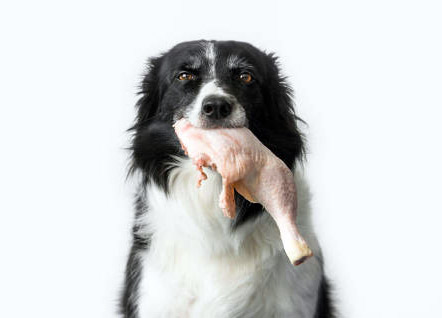
Image of dog holding raw chicken in the mouth

The westerners are famous for adding Garlic to their Teriyaki Chicken recipe. Garlic is also another toxic ingredient for dogs, although not as much as Xylitol. Garlic can result in oxidative damage, which affects the RBC of your pups. It can cause hemolytic anemia within a short time if taken in large amounts.

If your pup accidentally consumed Teriyaki Chicken in a moderate amount, you might notice vomiting and diarrhea for a few hours. This is normal, and you should be careful to keep the Teriyaki Chicken out of its reach in the future. However, if the consumed quantity is high, diarrhea and vomiting can be severe and will last up to 24 hours.

The best way to deal with this is to seek the help of a professional vet. Activated charcoal and a lot of fluids can relieve the symptoms of your pup and make it healthy again.

Image of Teriyaki Chicken
Teriyaki Chicken with vegetables

What About Feeding Your Dogs Recipes Involving Teriyaki Sauce?

First, let’s talk about how Teriyaki Sauce is made. It is a mixture of soy sauce, sake (or wine), and sugar (honey and Xylitol are some alternatives). Furthermore, in western areas, they also add garlic for extra flavor. These ingredients are boiled until the required thickness is attained. After that, the sauce is added to the meat which is then grilled or boiled.

Soy is renowned for inducing allergies in dogs. So, if your dog is allergic to foods, you should avoid any soy ingredients. If humans consume soy sauce in large amounts, it can lead to many health complications. Thus, the results can be even more severe to your fur friends. One of the ingredients in soy sauce is sodium. It is only safe in minimal quantities and thus not recommended.

Soy Sauce also contains too much salt, which can lead to salt poisoning in your dog. In addition, there is this chemical named ‘histamine’ which can be harmful. Another troubling ingredient in the Teriyaki Sauce is sugar. There are many cases of diabetic dogs due to the regular use of sugar. Not only this, but it can also result in periodontal disease.

Xylitol is a sugar alternative in the Teriyaki Sauce. You might think this will prevent your dog from diabetes, but this chemical is even more harmful. Even the smallest portion of Xylitol can be life-threatening for pups.

It causes a rapid and massive drop in blood sugar. In worst cases, your dog can experience seizures and liver failure. Some also use honey as a sugar alternative. It is relatively safer for dogs.

Finally, there is garlic. It is known to cause oxidative harm to your pet. The bottom line is that Teriyaki Sauce should be avoided at all costs.

Teriyaki Pork

Pork is amazing for the growth and nutrition supply to your pup. It is tasty and full of protein that helps maintain healthy fur, skin, and nails. However, when marinated in Teriyaki Sauce, pork also becomes an unhealthy diet for your dog.

Due to the harmful ingredients in the Teriyaki Sauce, it is better to serve your pup with natural pork rather than embellishing it with the sauce.

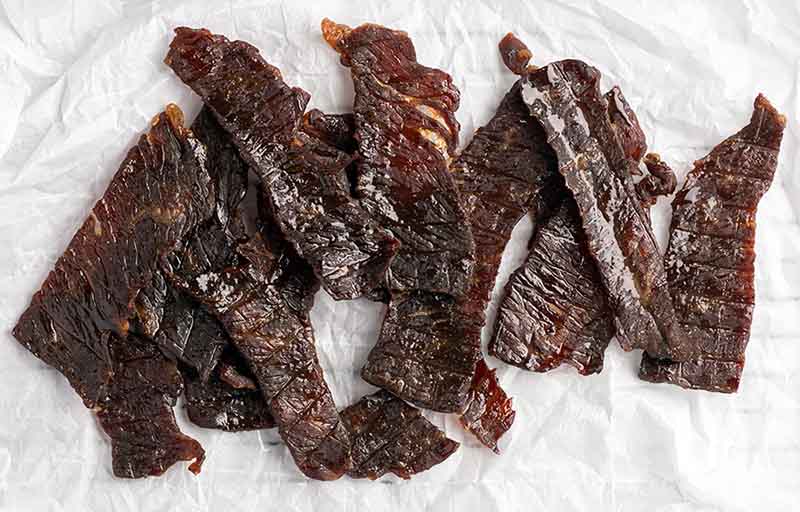
Teriyaki Beef Jerky

Anything that has Teriyaki on it should never be fed to your dog. In addition, beef jerky can also have some nasty compounds depending on the ingredients.

If the beef jerky is homemade and you haven’t added anything that could affect your dog, it can be safe. However, artificially produced beef jerky should be avoided.

Image of teriyaki beef jerky
Teriyaki Beef Jerky

Conclusion

Even though meat is a crucial part of a dog’s diet, you should never use it with Teriyaki sauce. When consumed in small amounts, the dog may show signs of vomiting and diarrhea. This subsides in a few hours and does not require expert help. However, if your dog eats the teriyaki ingredients in large amounts, you should rush it to the emergency ward.

Summary Table

Items Remarks
Teriyaki Sauce Not safe to feed your dog.
Teriyaki Chicken Not safe.
Soy Sauce May induce allergies. Not safe as it contains Sodium, Histamine, and a lot of salt.
Sugar It May cause diabetes and periodontal disease.
Xylitol Extremely dangerous.
Garlic Oxidative damage.
Honey Relatively safe but only in moderation.
Teriyaki Pork Not safe.
Teriyaki Beef Not safe.
Beef Jerky It depends on the ingredients used while making jerky.

We assume you got enough insights on whether dogs can have Teriyaki Chicken or not from this article in order to keep your dog safe.

Can Dogs Have Condensed Milk? Know Before you Feed.

As dog owners, it is crucial for you to know what you can or cannot feed your dog. Thanks to the biological differences, not everything edible to humans can be eaten by dogs and vice versa.

Dog owners ask if their dogs can have condensed milk all the time. In addition, we have seen queries regarding other milk and dairy products. As a rule of thumb, if your dog is lactose intolerant, any form of milk should be strictly avoided. In other cases, you can feed most of the milk variants.

Thus, this article summarizes well-researched information on the types of milk dogs can and cannot eat. Let’s dive in.

Can Dogs Have Condensed Milk?

The short answer is ‘yes.’ However, condensed milk is sweetened. They are also full of nutrients and calories. Thus, if you regularly feed condensed milk to your dog, it might encounter some health problems.

Firstly, there is the risk of tooth decay due to the sweetness. And then there is the risk of obesity due to too many calories. If you have a lazy dog who does not run and exercise often, it is better to keep it away from heavy calories and a nutritious diet. So, if it is on rare occasions, you can definitely treat your pup with some condensed milk.

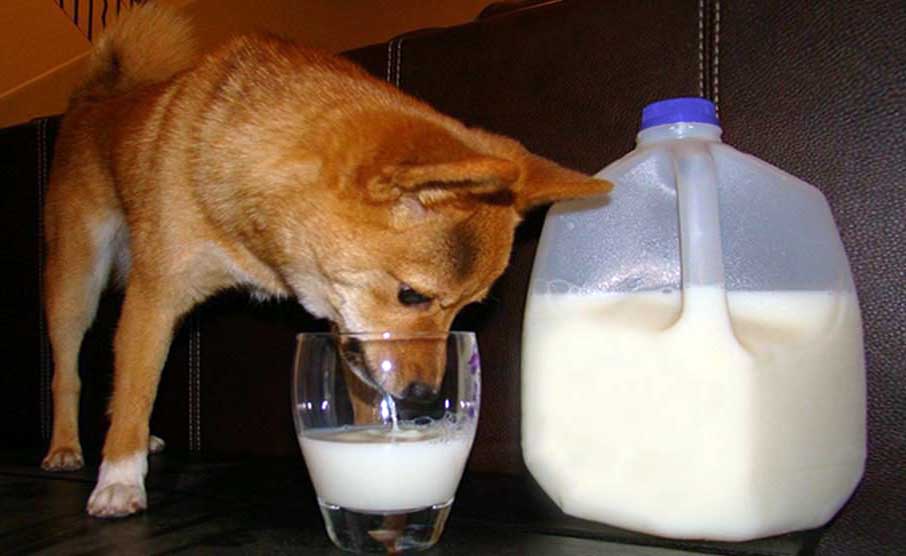
A dog owner made a query in justanswer.com. Her problem was that her pup drank an entire can of condensed milk. In reply to the query, Dr. Elaine mentioned that eating a can of condensed milk isn’t necessarily a health hazard. However, due to the sweetness factor of the whole can, the dog might experience diarrhea.

Image of dog drinking milk

As a result, Dr. Elaine suggests that you should give some bland food to your dog if it consumes excess condensed milk. Refraining from solid food and giving it only water overnight is also a good option. If severe diarrhea develops, it is best to consult a professional.

What About Coconut Milk?

Coconut milk is edible for dogs and beneficial when eaten in moderation. The main advantage of eating coconut milk is that it makes the dog’s fur soft. In addition, dogs love the product.

Can You Feed Your Dog Soy Milk?

We take a neutral ground in this one. Soy is irritating to many dogs as it is among the primary food allergens. Thus, if your dog is allergic to any food, chances are it will hate soy milk.

Furthermore, this milk is high in calories. The artificial and industrially produced soy milk also has added sugars. Thus, feeding them frequently can result in tooth decay. The bottom line is that if your pup loves soy milk, you can feed it occasionally in moderation.

Almond Milk Can Be Risky!

Almonds are nutritious nuts/seeds. They are also one of the top plant-based milk. And if the milk is natural and homemade, it wouldn’t hurt to treat your dog with some of its goodness.

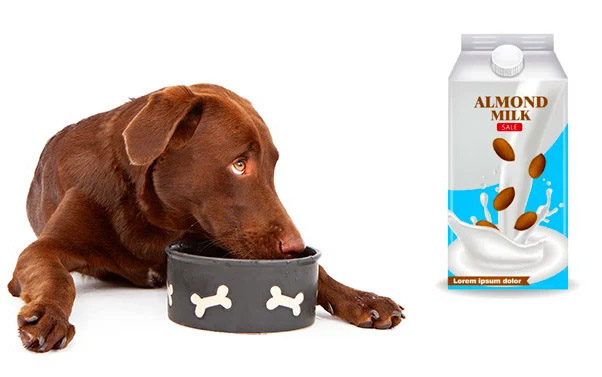
However, artificial and industrially produced almond milk can be extremely dangerous for your dog. Many doctors think that it can be life-threatening. In artificial almond milk, a compound name ‘Xylitol’ is found.

And this compound is toxic to dogs in general, which can cause several health problems or go beyond. Thus, artificial almond milk should be avoided at all costs if you care for your pup.

Image of dog with almond milk
Almond milk is harmful to dogs.

What About Cow and Goat Milk?

According to Healthline, Cow milk has the highest fat of all. We all know what this means. The high-fat content can bring out some problems in your dog, like obesity and pancreatitis. It also has a natural sweetness factor and is not easily digestible.

However, dogs love cow’s milk the same way humans do. And it is perfectly fine to treat them occasionally without establishing a habit. Furthermore, if your dog looks like it needs some fat and nutrients, you can definitely feed it more often.

Goat milk is similar to cow’s milk except for the fact that it has less fat. Furthermore, it is also easily digestible. Thus, we prefer feeding pet dogs with goat milk rather than cow milk.

Milk Compatibility Table for Dogs

Condensed Milk Edible in moderation. It can cause diarrhea if given in excess.
Coconut Milk Healthy for dogs.
Soy Milk Causes allergic reactions in many dogs.
Almond Milk Safe if homemade.
Artificial Almond Milk It contains ‘Xylitol.’ Dangerous!
Cow Milk High-Fat Content. It May cause obesity.
Goat Milk Better than Cow milk for dogs.

Hope this article answers your question about whether or not dogs can have condensed milk.

Do Dogs Get Tired of Barking? How to Stop Dogs from Barking Excessively?

Dogs are a blessing to humans. From being a man’s best friend to security, you can count on these paw-friends for anything. They also make up for excellent investigators and livestock herders, thanks to their enhanced senses.

Similar to humans, dogs have to be raised well and taught positive behaviors. While their woof and ruff can be pleasing to hear at most times, it is equally irritating when the barking is loud and consistent.

This article provides in-depth research pertinent to Bark Control facts and the misinformation that surrounds the topic. Do dogs ever get tired of barking? And how can you control them? Let’s find out.

Dogs Never Get Tired of Barking

An incessantly barking dog is a nuisance. And while you might think that it will stop in minutes, the dog can keep on for hours until the cause is addressed.

Dogs never get tired of barking. The best-case scenario is that they will slow down. It is the only tool they have at their disposal to inform and communicate to their owners as well as other dogs.

There are many tested and proven ways to stop an unnecessarily barking dog. These ways range from simple behavior enforcement to harsh bark control collars.

These furry animals bark when they are afraid, hungry, cold, excited, and basically everything. It is up to you to figure out why your pet is being a nuisance and solve it as soon as possible.

If it is a neighbor’s pet and is disturbing your peace of mind, you can consult them to take necessary actions. If all else fails, there are always laws to solve your problem. Filing a police report would be a logical move.

Some Dogs Bark at Everything That Passes By

If your paw friend barks at everything that passes by, it is most likely a territory, alert, and social barking combined. Let’s look at what they are.

1. Territory Barking

Dogs claim their owner’s territory as their own. In addition, the walkways and usual playgrounds that they are familiar with also count as territory for them.

Territorial Aggression in Dogs

The territory barking is mostly to assert dominance and scare the intruder to go away. Your dog will not stop barking until the intruder, or the object has left its sight.

2. Alert Barking

If something startles your dog, it will get alert and start barking. The causing factor can be strange noises, objects, dogs, and even people. Their ears are sensitive to loud/high-pitched noises.

Similarly, they can also be alerted by incoming climatic threats like hurricanes and earthquakes.

Alert Barking by dogs

3. Social Barking

Dogs need to be properly socialized as a puppy. When you see two dogs bark at each other from a distance, it’s just them communicating. Oftentimes, they don’t even need the visual and communicate with just sounds.

If they are showing aggressive behavior in combination with the bark, it is due to poor socialization. They are most likely using the incessant barking as a self-defense mechanism.
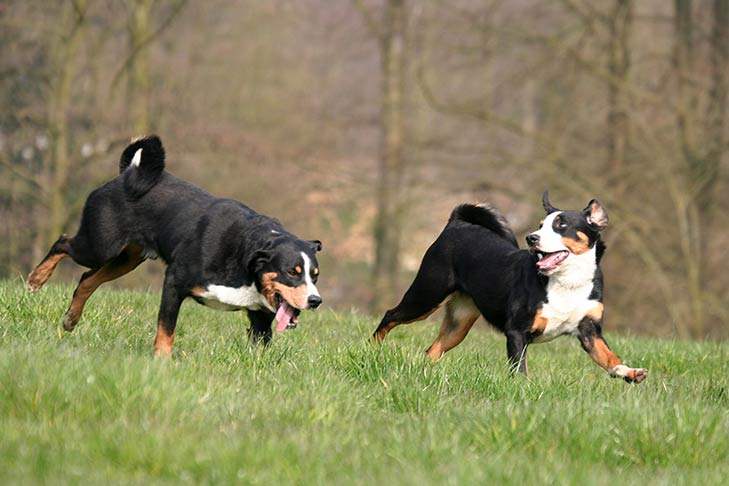
Social Barking by dogs

Why Do Dogs Bark Excessively?

Barking is natural to dogs. They communicate their emotions through this. However, when they bark continuously, there is usually a trigger that motivates them to do so. Let’s look at some niche cases for excessively barking dogs.

i. Barks When They See Other Dogs

There are multiple reasons why dogs bark at other dogs. They are probably socializing. When the bark is followed by excitement signs, wagging tails, and pacing, it means that they are eager to play and socialize with other dogs.

And while their violent barks can convey to you that they are fighting, they could just be greeting each other. But, excessively barking at other dogs means the dog isn’t trained properly.
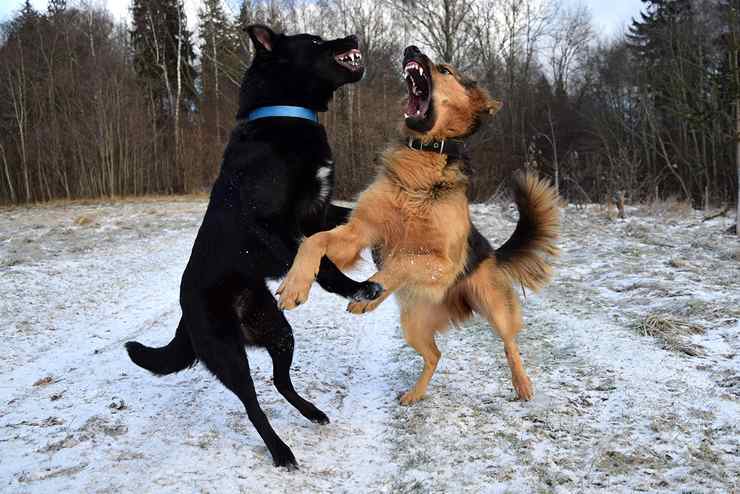
Dogs Barks When they See other Dogs

Unsocialized dogs tend to react to excessive barking when they see their kind. They usually are nervous and confused about how to react. Thus, they pull their leash and bark incessantly to warn other dogs to keep their distance.

Another reason is frustration. If your puppy was free and properly socialized in the past, but you have restricted it from being in contact with other dogs, it might feel frustrated. Dogs are easily attached and love the company of their kind. When they see other dogs on the street, they want to socialize by barking, smelling, and playing.

However, since the owner restricts it thinking a fight would break out, they feel limited. This leads to excessive barking. Another reason is that they are afraid of the other dogs and use their continuous barks as a self-defense mechanism. We can term these situations as ‘frustrated greeting.’

ii. Territorial Barking

When you adopt a dog, you are no longer the only owner of your property. Your dog marks its territory and takes the responsibility to look after it. Even if they are friendly dogs, they can react aggressively to people and pets they are not familiar with. Dogs are like a ‘do not trespass’ sign, but only meaner.

Excessive barking can start if a stranger walks into its territory. And the bark gets louder and more consistent when they get closer. It is normal to bark for a short period. But continuous barking is a behavioral problem. Your dog will not stop barking until the trigger is away from the territory.

You can recognize territorial barking because of the alertness and aggressive nature of the dog. And this is really troublesome because the territory isn’t limited to your home. It can be the streets where you walk your dog, your car, or even you.

iii. Alarm Barking

Dogs have better sensory capacity than humans. They notice every subtlety in their environment regarding smell, sound, and sight. Thus, they are also startled easily by certain noises and objects. Dogs bark excessively when they feel threatened or afraid. You can usually identify it as they tuck their tails, make their body still, and pull back their ears when they are afraid.

During alarm barking, your dog will pounce forward in small steps between each bark. What differentiates this from territorial barking is that it can happen outside of what the dog thinks is its territory. If something startles or frightens it, your dog will bark without interruption until you take care of the catalyst.

iv. Attention Barking

Dogs hate to be alone. They enjoy consistent affection and attention from their owners or from other dogs. However, if they bark incessantly to call for your attention, you have trained it wrong, especially because they can induce this behavior at night when you cannot tend to it.

Attention Barking by dogs

Attention-seeking bark won’t stop unless you provide the dog with its favorite toy or treat. It is a result of many reinforced behaviors that your dog has learned. For example, whenever a dog barks loudly, we shift our focus to it because human beings are automatically drawn to loud noise.

This convinces your canine companion that barking loudly and continuously is the best way to get your attention.

v. Separation Anxiety

Your dog is more attached to you than you think. Separation anxiety is a concerning issue that requires to be sorted out with expert help. It can lead to some destructive behavior in dogs that may cause self-injury or damage your house.

If your dog starts barking excessively when you are preparing to leave the house, it is a symptom of separation anxiety.

The continuous barking can also start a few moments after the owner has departed the house. The barks are accompanied by restlessness, escape tries, chewing on sofas and mattresses, and other destructive behaviors.

It shows that the dog is in distress. It is upset because of loneliness. Thus, taking medical and expert guidance is a must in this case.

Separation Anxiety by dogs

vi. Compulsive Barking

As lovely as dogs are, they also tend to be irritating at times. Some dogs that are untrained bark excessively for no reason.

They just love to spend their energy and boost their adrenaline. Barking is pleasant for all dogs. This is what they do to show happiness, anger, or distress.

However, ones with Compulsive Barking habits can go on for hours which is not acceptable to the owners and especially the neighbors. The same dogs are also more likely to be disobedient and chaotic with their surroundings.

Steps to Control Your Dog’s Barking

The first step would be to figure out why your dog is barking excessively. More often than not, the dog has reasons to continue this behavior.

It could be anything from another dog to an unfamiliar presence or even some alarming situations like an approaching hurricane or earthquake.

There are also cases where the dog just likes barking when it has nothing to do. Below are some measures you can employ to mitigate the excessive barking issue.

i. Behavior Reinforcement

A well-trained pup grows up to be an obedient and loving dog. If your dog barks continuously when it needs something, and it stops after its demand is fulfilled, that’s not the right way to reinforce its behavior. Instead, reward it for showing positive habits.

Do not provide it the treat or reward as it is barking. Wait for some minutes after your dog has stopped and treat it then.

This convinces your dog that the key to getting treats and cuddles from you is to stay quiet. Reinforce positive behavior from the early days even if it does not have a barking problem.

Behavior Reinforcement in dogs

ii. Motivation Removal

A dog usually looks at the cause when it is barking. Figure out what disturbs its peace and remove it from the dog’s sight.

If your dog barks at passersby, relocate it somewhere where it cannot see the road or just put up a barrier like curtains or windows.

There are also other motivations for it to bark, like hunger, cold, or a tight leash. Make sure to solve the problem, and the excessive barking will stop.

iii. Diversion

One way to stop your barking dog is to divert his focus to something that he enjoys more. It could be physical activities like playing or swimming.

When your dog is busy enjoying the water, it will prioritize playing over barking.

iv. Desensitize

Some dogs are habituated to bark or be uncomfortable with some specific things. If you cannot stop it from barking whenever it sees other dogs, try to expose it to the situation more.

Tell our friend to stay at some distance with his dog and treat your dog every time it does not react to your friend’s dog.

Slowly, close the distance until your dog is familiar and no longer sensitive to the situation. You can repeat the process with any other issues that your dog has.

v. Ignore

Oftentimes, your paw friends bark to capture your attention. And after a long barking session, if you fulfill its demand, a behavior reinforcement is activated.

Instead, ignore your dog as long as it is barking. After it calms down, wait for some time and reward it with a treat.

You may have to notify the neighbors beforehand if your dog is habituated to get your attention after barking because it will be a long time before it stops.

vi. Exhaust Your Dog

Dogs spend a lot of energy each day barking. If you keep it physically active and exhaust its energy in the daytime, the barking will reduce significantly.

Exhausting Dogs

vii. Muzzles

Honestly, it should never come to this. Animal rights activists think that using muzzles for your dog is abusive behavior. However, it does come in handy in emergency situations.

In the US, strict laws have been implemented for dog barking and disturbance. If your neighbor files cases multiple times, and the problem still isn’t solved, you may face up to 6 months in jail and other financial compensation. Here, the muzzle can be of use when there is no way out.

Moreover, dogs tend to bark and bite aggressively when they are wounded. If you try to take it to the hospital, there are chances of you getting bitten.

This is especially true with untrained dogs. Thus, you can also use the muzzles in such scenarios.

viii. Barking Control Collar

These are somewhat modest compared to muzzles. Today, many manufacturers have introduced harmless collars which emit smells and sprays that the dog dislikes.

Whenever a dog barks excessively, the collar sprays the liquid and thus startles the dog. It will stop barking to not experience it anymore.

There are also other barking control collars that give your dog a small electric shock when they bark. This, too, should only be used in emergency situations.

Barking Control Collar

ix. Take Professional Help

If you have followed the basic steps and still have a hard time controlling your dog’s incessant barking habits, we suggest taking professional help.

Veterinary professionals and dog trainers can solve the problem and stop it from escalating further.

Dog Barking in Sleep

You wake up in the middle of the night because you hear your canine friend barking. But as you approach closer, you see it asleep, moving its feet, twitching its ears, wagging its tail, all while still barking.

This is normal, and here are things to know if you have experienced this.

Why Do Dogs Bark in Sleep?

Like humans, dreams are natural for dogs. Some believe that they experience it even more vividly. Your paw friend might be chasing after rabbits or playing with you in its dream.

Or, in certain cases, if it is panting and tucking its tail, it might be having a nightmare. Whatever the case, it is normal for dogs to bark in sleep when they are in a deep dream.

Dreams are more common in small breeds as they tend to happen every 10 minutes when they are in the REM cycle.

For larger breeds like a German Shepard or a Golden Retriever, dreams appear at least once in 90 minutes. All humans dream but only some talk in their dreams. It is similar to dogs.

Dog Barking in SleepBarking Control Collar

Solutions For Dogs Barking in Sleep

If the occasional sleep barking does not disturb you, it is best to let the dog be and enjoy its dream.

However, if it disturbs your sleep schedule, you can relocate your dog to another room without waking it up.

For more severe cases, when the barking is unbearable, the best option is to contact your vet. Even though some sites have found solutions in using sleeping pills, we strongly advise against it. It is never a good idea to give your paw friend human medicine.

Also, if the dog is barking and panting and having breathing problems while asleep, it would be best to wake it up.

Famous Dog Trainer Cesar Millan talks about Dog Barking Control.

Cesar Millan is arguably the most famous and reputed dog trainer in the world. This has also endowed him the title of ‘Dog Whisperer.’

The dog trainer has released many videos and blogs on how we can take care of our canine friends effectively.

Furthermore, he also helps people who are facing behavioral problems with their dogs. Below are Cesar’s best tips to stop dogs from excessive barking.

i. Be Calm

You have to set a leading example for your dog. If you are frustrated, your negative energy will also affect it. Thus, try to be calm and handle the situation with grace.

ii. Use Commands or Sounds

Throughout the course of raising your pup, you have to establish some sort of commands or sounds that your pup can instantly recognize.

Cesar personally uses the ‘tsch’ sound. It is because it imitates the sound of a tire leaking air which is irritating to pups.

Thus, the ‘tsch’ will stop their mental inertia and readjust the focus of the dog. You can use any command that suits you.

iii. Divert the Energy

When your dog starts barking excessively, divert that energy for some productive tasks. Play games or take your dog for a quick swim.
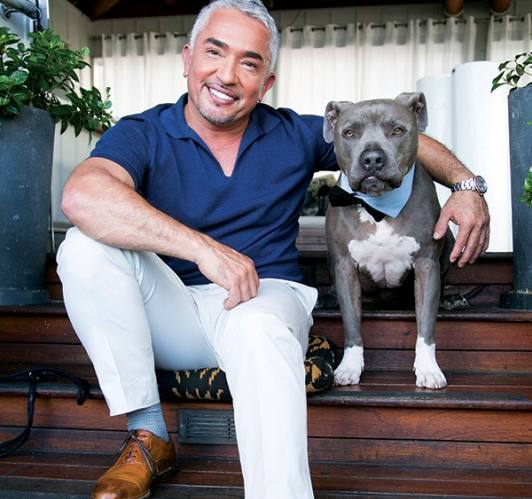
Famous Dog Trainer Cesar Millan talks about Dog Barking Control

iv. Correct and Reinforce Behavior

Whenever your dog shows bad behavior, correct it immediately and follow through until it stops. You must repeat this as long as your dog is well behaved.

v. Lead with Confidence

To quote Cesar’s words, ‘stop treating your dog like a human.’ Sometimes, you have to show your friend who is in charge of the situation. Always be strict when you have to.

Why Does Dog Bark at Nothing?

While a dog mostly barks when something troubles or excites it, the reason might be unclear in some cases.

Many owners claim that their dog barks at nothing, and it is almost impossible to make them stop. Below are some reasons and what you can do about it.

Attention

Your canine friend is an attention seeker. If it stops barking as soon as you look or pet, it demands your attention. If the barking is off-limits, you can solve this with positive behavior reinforcement.

Injury or Discomfort

Barking is how dogs communicate. Thus, it may seem like your dog is barking at nothing. But it wants to convey to you about its discomfort or injury.

If your dog is barking incessantly without any issues, browse his body for injuries and also check if the leash is too tight.

Potential Danger

Dogs can sense danger better than humans. For example, dogs can hear the earthquake frequencies or alert you about an incoming hurricane. Never ignore your dog’s bark if it is combined with rapid pacing and panting.

Compulsive Barking

Some dogs just love barking, and there is no other explanation for it. Seeking professional help will be the best if it hinders your peace.

Conclusion

Barking is normal behavior and should not be criticized until it violates the peace of mind of the owners or neighbors. It is your responsibility as a dog owner to train your puppy from a young age to tackle any problems that may arise in the future.

Barking habits that are deeply rooted can be hard to counter with homemade efforts. Thus, it is always a logical move to seek professional help.
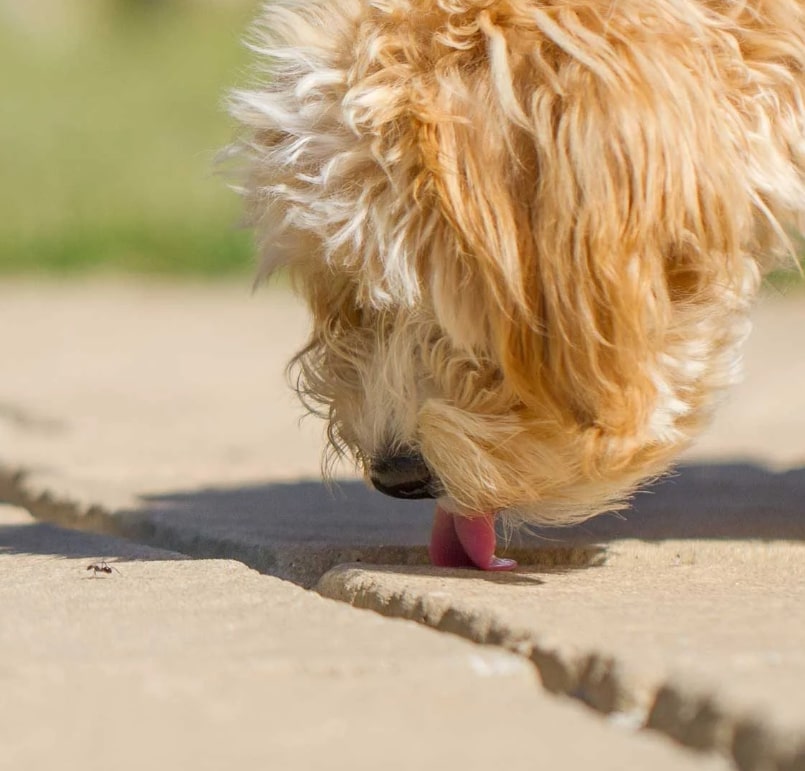

French Bulldog and Husky Mix Lifespan, Temperament, Facts

The Husky Bulldog Mix is a cross between the Siberian husky and the French Bulldog. At first glance, you’d think that this is a combination that should not exist. Huskies are wild, outgoing, ridiculously energetic, with a high prey drive. French Bulldogs, on the other hand, are reserved, chilled, and less active. So, what do you do if you cross the two?

Well, experts say that you’ll get a dog that takes after the two parent breeds. The husky bulldog mix is a unique dog that would make a great addition to most households. Well, provided they can cope with a little bit of madness.

Husky Bulldog Mix Lifespan

On average, the husky bulldog mix will live for about 12 years. If the conditions are favorable, then this dog’s lifespan can stretch to 16 years.

It will all depend on the kind of care the dog owner in question will provide. To live longer, these dogs will need a healthy diet, regular exercise, and frequent trips to the vet to ensure that everything is okay.

Husky Bulldog Lifespan

This is because the husky bulldog mix may be prone to health conditions like breathing difficulties and skin infections. Going to the vet will help keep these conditions in check, lengthening your dog’s lifespan.

Description and Appearance

The husky bulldog mix is a medium-sized dog that has a white coat, just like the Siberian husky. Unlike the aforementioned parent breed, however, this coat will not only be short but can also take on a variety of color combinations.

These include, but are not limited to fawn, tan, or even a hint of brindle. Another key feature of this mix is erect ears, which, if you haven’t already guessed, come from its bulldog ancestry.

Other than that, this bulldog will also have the dazzling blue eyes that most people have come to associate with the Siberian husky.

Husky Bulldog Description and Appearance

When they attain full maturity, this dog will weigh anywhere between 35 to 45 pounds. Typically, they will fall on the heavy end of the spectrum because of the husky genes. Height-wise, they can grow up to 22 inches at shoulder length.

Temperament and behavior

The husky bulldog mix is a loyal, sharp, intelligent, alert and energetic dog. Other than that, you’ll also have to contend with stubbornness, which is inherent in both the Frenchie and the Siberian husky.

Moreover, they will also have a high prey drive, which means that you’ll have to be careful if you have cats around as well.

Though friendly, the husky bulldog can also prove to be wary of strangers, particularly at night. They will howl relentlessly if the peace of your home is disturbed. This is a testament to the loyalty they have for their humans.

Husky Bulldog Mix Temperament and behaviour

Because of their need to please their owners, this husky will also be easy to train; though, we should point out that a little patience is still required, nonetheless.

You need to develop a solid exercise regimen for your dog to keep him both mentally, and physically healthy. Some owners have found great success teaching their husky bulldog mix how to fetch, and even put toys back in the proper place.

Facts about the Husky bulldog mix

  • If not socialized effectively, the husky bulldog mix could become aloof and aggressive towards strangers, or other dogs. They should therefore be introduced to other pets while they are still puppies.
  • On average, the husky bulldog needs about an hour of exercise every day, lest he becomes bored and, in some cases, destructive.
  • Because of its French bulldog parentage, this dog will have to contend with breathing difficulties. Other health problems they may face include skin infections (dermatitis).
  • Dietary-wise, the husky bulldog will need a steady supply of quality dog food and water. On average, experts say that you should give him at least 600 calories every day depending on their size. This number can go up if your husky bulldog is heavier.
  • These dogs will additionally make great companions for children. Their impressive stamina means that they can run around for hours on end without really getting tired.

Black and Tan French Bulldog Facts and Information

The French Bulldog is a popular breed in places like America and Europe. They have a long and storied history that dates to 19th century Paris, where they were initially bred. In terms of size, Frenchies tend to be small, stocky, with bat ears. Aside from aesthetics, most dog lovers opt for French bulldogs because of their easy-going nature. They do not need a lot of room and can cope in small apartments. In total, there are 14 different types of French Bulldogs. The black and tan French bulldog is one of the unique breeds available in the market.

Appearance and Description

As far as appearance goes, the Black and Tan French Bulldog has a stunning and shiny coat. These Frenchies also have remarkable tan marks across their limbs, eyes, and even cheeks to complete their look. One notable feature is the absence of brindle across their coats, which gives them an all-around sleek and regal look.

Like the rest of their kind, black and tan French bulldogs also have short, stumpy tails that look docked. This isn’t the case, however, as their short tails are a result of breeding.

Black and Tan French Bulldog Description Appearances

Black and Tan French Bulldog Lifespan

The Black and Tan French Bulldog can stand up to 12 inches tall, weighing as much as 20 to 28 pounds at full maturity. In addition to this, they can live for 10 to 14 years. This will depend on the type of care they receive throughout their lives.

Temperament and Behaviour

The black and tan French bulldog is a delightful dog to have around the house. They are friendly, affectionate, playful, attentive, and equally sociable.

When they bond with someone, they will hardly ever want to leave their side. This could, of course, create a sort of separation anxiety if they are left alone for an extended period.

The black and tan Frenchie thrives on human companionship, so if you are interested in an independent dog, then you should probably look elsewhere.

Another thing to look out for is their propensity to bark all the time. Alternatively, this might make them an excellent guard dog as they will bark when they sense a stranger in the vicinity.

Black and Tan French Temperament and Behaviour

Facts about the Black and Tan French Bulldog

  • The Black and Tan Frenchie can be mischievous if not trained effectively. You need to be patient when teaching them, as they are fiercely stubborn and independent thinkers.
  • Because of their thin coats, grooming is not an issue with these dogs. Moreover, they will not shed as much as other dogs with thicker coats.
  • The black and tan Frenchie is a dog that does not need much exercise. In fact, they only need about 15 minutes every day to meet their exercise requirements.
  • Like other types of French bulldogs, you need to be careful when taking your black and tan out on hot days. They cannot cope with the heat and better cope in air-conditioned houses.

Alaskan Noble Companion Dog Weight, Temperament, Facts.

The Alaskan Noble Companion Dog is a stunning and beautiful dog that closely resembles the Tamaskan and the Northern Inuit Dog. Because of its unique look, the Alaskan Noble Companion has been attracting significant attention lately. Its popularity can be attributed to its close resemblance to the dire wolf, an animal heavily featured on Game of Thrones.

As far as the breed’s history goes, research shows that it was first bred back in the 90s. It also derives the first part of its name from its relationship to other Northern-looking Breeds. From here on, we’ll talk about the breed’s temperament and other significant facts.

Alaskan Noble Companion Dog Weight and Height

The Alaskan Noble Companion Dog is classified as a large breed. On average, they should ideally weigh anywhere between 60 to 110 pounds (27kg to 50kg).

They also measure in at 26 to 33 inches when they reach full maturity. How does this measure up to other larger breeds? Well, when fully grown, the Alaskan Malamute, for instance, can grow up to 43 kg. It further highlights just how big the Alaskan Noble Companion Dog is.

Alaskan Noble Companion Dog Temperament

The Alaskan Noble is a working dog who is very energetic. As such, it can be used in a variety of activities, ranging from herding, tracking, agility training, hiking, to mushing.

Because of their high energy drive, you must make sure that they get at least 2 hours of exercise every day. Though they are good with family members, the Noble Companion Dog can be very standoffish with people he doesn’t know.

Alaskan Noble Companion Dog Temperament

So, you need to be very wary when introducing him to new people. Additionally, there is also an argument that they might display aggression or a higher prey drive. This is because of what experts call a ‘high wolf content.’ If not reigned in, this breed can prove to be aggressive and destructive.

So, how easy are they to train? Well, like all other large dog breeds, they need a firm and steady hand. If you are a novice dog owner, then you should probably look elsewhere.

Because the Alaskan Noble shares a few traits with a husky, it is highly sociable with other dogs. Therefore, it could potentially be an excellent addition to a home with other dogs.

Alaskan Noble Companion Lifespan

The official lifespan hasn’t been documented. However, some pet owners say that the Alaskan Noble Companion’s life span ranges from 13 to 17 years. This compares favorably to other large dog breeds, which typically live up to 10 years.

Alaskan Noble Companion Lifespan

Facts about the Alaskan Noble Companion

  • Because it shares traits with the Malamute, this breed can be highly dominant, especially with early male dogs. It will take a significant amount of training to keep this characteristic in check.
  • The ANC is a rare and unique breed. Consequently, most breeders will sell a puppy for about $800 to $1000.
  • Because of its double coat, this breed will shed frequently. You’ll need to brush them regularly in order to keep their coats healthy.
  • As far as their diet goes, this breed will require a healthy dose of protein. If you want to give them manufactured dog food, then you should opt for high-quality kibble with a protein content of about 20%. Other than this, you should also consider a raw diet because of its wolf-ancestry.
  • Typically, the Alaskan Noble Companion will have a dark, black coat. Additionally, they may also bare signature white markings across their chest.
  • This breed also has distinctive eyes that are dark by default.